Showing posts with label Farmers' Market. Show all posts

Saturday, April 3, 2010

The Grayslake Farmers Market Begins Again

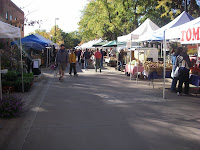
This morning in the drizzling rain Naomi and I ventured to downtown Grayslake to once again stroll through the booths. I felt a giddy sense of spring as I went from one vendor to another. It felt good to say hi and see people again.

Of course tomorrow is Easter and I saw many people purchasing eggs. One couple purchased ten dozen farm fresh eggs from one vendor. Naomi and I bought cheese, bread, juice, and got my CSA share.

Saturday, November 14, 2009

A Refreshing Night


Last night Naomi, Five Crows, Fractured Thoughts, and several others got together for a pot luck meal made from locally grown and raised food. We had salads, green bean casserole, pot roast, pork tenderloin, apple/ leek cheese pastries, and apple cranberry crumble for dessert. The food was excellent and the company was even better.

The impetus for this occasion was the screening of FRESH the movie at the barn in Prairie Crossing. There have been quite a few movies of late about the issue of agriculture and our food industry. I would not suggest this as someone's first movie about current issues in the food and agriculture industry, but it did have some informative insights as well as a thorough interview of Joel Salatin of Polyface Farms. Joel was as entertaining and informative as he was in Food Inc., however this movie covered his views and the reasons for his farming methods better than any other movie he has been featured in. Of course I think Michael Pollan, the founding father ofmodern food reform, explains him the best:

I asked Joel how he answers the charge that because food like his is more expensive, it is inherently elitist. “I don’t accept the premise,” he replied. “First off, those weren’t any ‘elitists’ you met on the farm this morning. We sell to all kinds of people. Second, whenever I hear people say clean food is expensive, I tell them it’s actually the cheapest food you can buy. That always gets their attention. Then I explain that, with our food, all of the costs are figured into the price. Society is not bearing the cost of water pollution, of antibiotic resistance, of food-borne illnesses, of crop subsidies, of subsidized oil and water — of all the hidden costs to the environment and the taxpayer that make cheap food seem cheap. No thinking person will tell you they don’t care about all that. I tell them the choice is simple: You can buy honestly priced food or you can buy irresponsibly priced food.” Source: No Bar Code, Mother Jones

Also Michael Pollan's book Omnivore's Dilemma best explains Joel Salatin's farming views and ideas.

The other main character of this movie is Will Allen, a self described food industry drop out. Will is the founder and president of Growing Power, which is an organization that has a simple goal; to grow food, to grow minds, and to grow community. Will started this organization simply enough. He wanted to find work for the teens in his community and to give them a job that would help them give back to their community. From this humble beginning this organization has transformed into a national commitment to sustainable food systems. Growing Power not only provides for its immediate neighborhoods, but also serves as a training facility to teach others how to replicate the methods that they use.

Will Allen produces about $850,000 of health fresh food on just three acres of land in the middle of an urban jungle. Growing Power has six greenhouses, ten hoophouses, pens for goats, turkeys, and chickens. They also have a sustainable system for raising 10,000 tiliapia and perch. Proving to everyone that you can grow a large amount of food on a small area and that people who live in the urban "food deserts" do not need to settle for just processed foods. Everyone is entitled to the right to enjoy fresh delicious produce and meat.

So my recomendation is go see the movie, but if this is your first trip into the world of Slow Food, or agriculture revolution then don't stop here and keep on reading and watching. Your body, mind and soul will thank you for it.


If there are no upcoming screenings in your area, please contact the director to get a DVD to host a local screening in your home or community center.

You can also become a fan on Facebook (they list the upcoming screenings on there, too).


Sunday, October 25, 2009

A Boulderific Farmers' Market


Earlier this month Naomi and I went on a trip out west. Our first stop was Boulder, Colorado for her brother's wedding. While we were out there we heard quite a bit about the fabulous farmers' market that they had. The previous year we had seen Denver's, but her brother told us that nothing could beat Boulder's. So we went to have our own look.


Boulder's farmers' market took up several blocks and incorporated many local farms. Some who specialized in specific crops, while others had your typical variety.


I was a bit sad that I had not driven to Boulder and therefore could not purchase much if any of the wonderful foods that were on display.


Speaking of specialty farm stands, this stand from Wee Bee Farms only had garlic. The stand had about 12 different varieties. Naomi and I picked up two bags of assorted garlic. One for planting and one for cooking with. We ended up with Chesnok Red, Inchelium Red, Chicago Italian, Peskem River, Lortz Italian, Shatili, Shantung Purple, Rose de Lautrec and a few more. (More on Garlic later)


Some stands such as this one clearly made a habit of sprucing up their tables to attract customers. There were clearly over 25 farms on attendance at this market.


Additionally, there were quite a few artisan cheese makers, bakers, and a variety of other stands


Another place that we did purchase some goods was this apple orchard stand. There were at least 6 different varieties and of course we had to try each one to know what was best.


At this farm stand you could buy freshly ground flour made from whole wheat grain. Wish we had something like this at our local farmers market.


Another interesting stand was this one, which sold fire roasted peppers made to order.


Well Boulder's farmers' market was as good as its publicity. Anyone who travels through this area in the late spring, summer, or early fall should definitely stop by this one on a Saturday morning or afternoon.

Wednesday, September 23, 2009

I'm Back! With Quite a Bit to Say

Well I could say that I have been out of contact due to work, but that wouldn't be exactly true. I could say that I haven't written anything because there is nothing to say, but that would be an out right lie. All I can say is that I had writers block and just became a bit gun shy. Well I am going to bite the proverbial bullet and go for it.

Well there is quite a bit to write about and one of my favorite events that has happened, since my last blog, was the student made marinara sauce. Each spring my classroom plants wheat that will be harvested by the next classroom the following year. The wheat is used to make bisquits for the rest of the school as part of a luncheon called farm to table. Well last spring I decided to add one more crop to our farm plot, tomatoes. Tomatoes are a great all around crop that you can make many different products from. One of those products is marinara sauce, which is a favorite of almost all kids.

Over the summer students took time out of their own summer to come out to the farm and help weed their wheat and tomato crops. Both were harvested within our second week of school (Side note my classroom were filmed on a WGN news story while they were harvesting the wheat). Unfortunately, many of our tomatoes were lost due to the blight. Luckily, what we were missing was made up by parents donating their own backyard tomatoes and from parents donating money so that we could buy more the following day at the farmer's market. I also bought many of the other ingredients at the Grayslake Farmer's Market from money that was donated by the students themselves.

The day after the market my classroom with several parent volunteers worked together to make marinara sauce. The students were immersed into the process with many of my brave boys running from the kitchen crying from the overpowering onions. Others learned how best to "gut" a tomato. Students worked hard in a hot kitchen peeling, gutting, dicing, mincing the tomatoes and the other ingredients. For lunch we all had pasta and sauce. That day the students learned that a sauce you make on your own with fresh ingredients will always be better than anything you can buy.

I believe that each student left that day full of pride and desire to make their own marinara at home.

The Recipe We Used:

24 pounds of Tomatoes
6 pounds of Onions
6 bulbs of Garlic
Salt and Red Pepper to taste
12 bunches of Basil
6 bunches of Oregano
4 bunches of Thyme
4 sprigs of Rosemary
and 10 leaves of Sage (my students chose this one because they liked the sound of it)
In a large pot Sautee onions and garlic in olive oil until onions are opaque
Add Tomatoes
Stir and mash tomatoes periodically as needed

Sunday, August 9, 2009

England! What can I say but...

Brilliant! The trip to England was truly a remarkable trip. I had a wonderful time in southern and southwest England. Seeing Durdle Door and Corfe Castle was rich in breath taking scenery. The little villages were quaint and magnificent. Naomi and I were able to visit a couple of farmers' markets here and I was surprised by the slight differences. There the farmers or vendors call out much like a hot dog or beer vendor at a baseball game. The markets were full of new and interesting vegetables such as the broad bean and a few others. I quickly learned that some new veggies were just different names. I found England to be a much friendlier place to small farmers and local food systems. This may be in part due to the Prince of Wales. Prince Charles seems to be a champion of local farms and good food. His influence can surely be felt throughout England. In grocery stores veggetables and meats will proudly claim where the food came from and who grew it if it originated in England. This is a wonderful small gesture that I am sure helps to encourage locavorism.


Thursday, July 30, 2009

HR 2749 Food Safety Enhancement Act-Update

HR Bill 2749: Food Safety and Enhancement Act of 2009 Failed yesterday. This is a victory for all artisan food producers and locavores.

Although I supported some of the ideas of this bill and especially the spirit of it. The major problem is that this bill is that it would treat all food vendors the same from your local bakery, like Wild Flour Bakery to the company that makes Wonder Bread, Interstate Bakeries (doesn't that sound delicious). This bill assumes that they are all on the same playing field. This just isn't the case local artisan producers make their food by hand and through love of their product and using high quality ingredients make food that will naturally be better for all of us. However this bill would have made them and the big businesses pay a $500 fee and do a "Hazard Analysis" study. This $500 would be enough that some small producers would fold and the paper work in a "Hazard Analysis" study would be enough to bury many small businesses. Whereas the large businesses such as Kraft would not blink an eye at the nominal $500 fee and would have enough interns or other low paid employees to do the mountainous paper work required by this bill.

Another issue I had with this bill concered "interstate shipping", which would make any producer who engaged in shipping their products across state lines to have a "Food Safety Plan". This would be the same plan for River Valley Kitchens who sell at our local farmers market, but are from Wisconsin as it would be for BG Foods. Under this bill they both would have to develop a food safety plan that included all of these elements:
  1. preventive controls being implemented;
  2. procedure for monitoring preventive controls;
  3. procedures for taking corrective action;
  4. verification activities for the preventive controls, including validation, review of monitoring and corrective action records, and procedures for determining whether the preventive controls are effectively preventing, eliminating, or reducing to an acceptable level the occurrence of identified hazards or conditions;
  5. record keeping procedures;
  6. procedures for the recall of articles of food, whether voluntarily or when required;
  7. procedures for the trace back of articles of food, whether voluntarily or when required;
  8. procedures to ensure a safe and secure supply chain for the ingredients or components used in making the food manufactured, processed, packed, transported or held by such facility; and
  9. procedures to implement the science-based performance standards issued.
I am a teacher and in education we have a saying, "Fair doesn't mean everyone gets the same it means everyone gets what they need." This bill was just wrong because it tried to make every play by the same rules, however everyone wasn't playing the same game. I believe that if this bill had passed it would have closed many good small businesses who serve a great healthy alternative to the mass produced junk that lines our grocery stores.


Bill Summary:
House Voting Results (check to see how your representative voted and let them know what you think):

Friday, July 24, 2009

Arkansas Traveler Part III-Peaches, Pink Tomatoes, and Seed Saving

On our way back from Arkansas Naomi and I could not leave without stopping at a farmers' market and a roadside market while we were still in Arkansas. So it was that at 7:30 in the midst of a torrential down pour that we went to the Argenta Farmers' Market in downtown North Little Rock. Standing in the rain I got to speak to a couple of the farmers and bought two baskets of peaches and half dozen or so Arkansas heirloom tomatoes, the Arkansas Travelers Tomato.

The Arkansas Traveler is a pink tomato that is supposed to have less acidity than its red relatives. This tomato is beloved in Arkansas due to its natural resistance to cracking and splitting as well as its superb taste. Four of the tomatoes made their way to topping a pesto pizza last night, one was a gift to a good friend, and the last one I harvested its seeds.


Seed saving the tomato was much easier than I expected and to tell you the truth I wasn't expecting much. Here is the process:
Select to save seeds from a tomato that has a flavor that you love....if you're a home gardener and saving seeds from tomatoes that are growing in your garden choose tomatoes from the very healthiest looking plants.

Take your chosen tomato and slice it in half across the middle (it's "equator"). With a spoon or your well-washed fingers scoop out the seeds and their gelatinous "goo" into a clean cup or container. Add a couple of tablespoons of water to the seeds. Cover the container with a piece of plastic-wrap and then poke the plastic-wrap with a paring knife or pen point to put a small hole in it...this is to allow for air-transpiration. (A little fresh air needs to get in and out of the cup to help foster fermentation.)

Place the container of seeds in a warm location; a sunny windowsill or the top of the refrigerator are both excellent sites to place the container of seeds. Now Mother Nature will take over and begin to ferment the seed and water mixture. This takes about two or three days. Each night remove the plastic-wrap, stir the seed and water mixture, and then replace the plastic-wrap, if you use a new sheet of plastic-wrap then don't forget to put a small hole in it for air-transpiration. The top of the liquid will look "scummy" when the fermentation process has separated the "goo" from the seeds. It also helps destroy many of the possible tomato diseases that can be harbored by seeds.

Take the container of fermented seeds to the sink and with a spoon carefully remove the scummy surface. Then pour the container's contents into a fine kitchen sieve and rinse the seeds with water several times...stir them while they're in the sieve to assure that all surfaces are thoroughly rinsed. Give a few sharp taps to the sieve to help remove as much loose water as possible from the seeds.

Line an open plate with a piece of waxed paper or a large automatic-drip coffee filter. Place the rinsed seeds onto the wax paper or coffee filter and spread them about so they are in a single layer. Place the plate in a safe location where the seeds can dry for a few days. Stir the seeds a few times during the drying process to assure that all their surfaces are evenly dry. Spread them out again into a single layer after each time you've stirred them. Tomato seeds are thick and can take up to a week to dry thoroughly. If you're having a rainy week that drying time may lengthen by a few days.

These seeds I will save for next year and try to grow some of my own. This variety enjoys hot humid weather and takes approximately 85 days to bear ripen fruit.


We also bought peaches at the farmers' market and a roadside stand that was in the parking lot of a gas station in Brinkley. We bought a total of 48 peaches that Naomi used to make jelly, she canned some, and she froze some of them as well. Of course as luck would have it we got another dozen in our CSA share as well.


Monday, July 6, 2009

Birthday Party and some good local eating

This past Friday Naomi and I threw a birthday party for her mom. We decided as soon as we sent out the invitations that most of the food that we served would have to be grown locally. We did not go out and buy a bunch of stuff at the grocery store. In fact the majority of the produce came from either our garden or the CSA and the meat all came from the farmers' market. (The only main item that came from the grocery store was the pasta for the past salad.)

Naomi made some great salads; a pasta salad, a beet salad, a raddish salad, and lastly a fresh green salad. We also served some good buffalo summer sausage and some local cheeses from The Cheese People. All of the meat that we served was from Lester's Buffalo Farm which is just up in Wisconsin. We had ground buffalo for hamburgers, some bratwurst, and some hot dogs for the kids. I was told the hot dogs tasted a little different, but the brats were much better than conventional store bought ones in my opinion. Heck even the wine we served was from a local winery, Glunz. More on them in a future post.

For desert Naomi made two strawberry and red currant pies that were gloriously delectable. A perfect end of the meal.

Wednesday, July 1, 2009

Farmers' Market and Party

Its a bazaar. That is the only way to describe the party that happens on Wednesday afternoons in downtown Grayslake. This Farmers' Market has everything from locally grown vegetables and meat to entertainers and jewelry. One can find a veritable cornucopia of sauces, jellies, salsas, bread and many other baked goods as well. The Grayslake Farmers' Market is a giant celebration of local goods and merchants. The sidewalks are packed almost to the point that one can't shop without bumping into someone. Yet the fact is that when you do there are no mean looks just a nod or short reply. Everyone knows that when the sidewalks and streets are packed its a good day for local farms and merchants. And these are the people we should be helping.
Want to stimulate the economy, America? Go to your local farmers' market and buy the groceries that you need. I know that it might be a little more expensive, but I promise that every penny and dime you spend there is well worth it. First, the money you spend there all goes toward the local economy. Unlike those big box stores where only a fraction of your money stays in the local economy. Secondly, the food you buy there is better for you and your family. It hasn't been shipped 1500 miles to reach that shelf and a small farmer will take better care of his crops. Because his or her name is attached to each and every single item that they sell. So, stimulate America's economy through farmers markets and local businesses.


Booth of the Week
At the market one of my favorite booths is back, The Cheese People. I have been waiting for them since the last summer market day of last year. As you could probably guess they deal in cheese. But this is not just any cheese. It is divinely inspiring cheese. Their Parmesan is so good that Naomi and I buy two chunks each week. One to eat that week and the other to freeze for those long winter months when we can no longer buy it at the farmers market. Need I say more about it. Their cheddar is wonderful be it the 4 year or the 8 year. And of course the Gouda is quite extraordinary and great cheese to buy when one is going to have a party.

Thursday, June 25, 2009

PYO Farms

Pick your own is a very interesting idea and I feel that it can only exist in cultures who no longer have a large base of agriculture. It is a way for many people to give themselves or their children of a sense of what it might be like to be on a farm. If farming was only picking and eating. However, I cann't begrudge this idea at all. For one it is a great way for family farms to keep going and to capitalize on a type of industry that Americans do so well; Tourism. I have been to farms that are more amusement park than actual farm. A second reason is that honestly this could be the closest some of these families ever get to the source where their food comes from. If nothing else they will know what a strawberry plant looks like and how to tell when they are ripe enough to pick. Lastly I participate in this phenomenon as well. Buying strawberries by the quart can become expensive from the farmers market($5 a quart), but PYO is less than half the price of the farmers market strawberries.

So it was with this last idea in mind that Naomi, myself, and two of our good friends went to McCann Berry Farm in Woodstock, IL to purchase some strawberries at a discounted price and to help support a local family farm. The McCann Berry Farm was well run and they even had people in the field to help direct you to a row that had not yet been picked. So one doesn't waste their time going up and down rows or sections that have already been picked over. I also found a bit of camaraderie with the other people who were picking. Some helped direct others to where the berries were bigger or more plentiful. By the end of the hour we had 5 buckets of strawberries or 20 quarts. Our Friends Kelly and Kathy collected some peas and also helped us to fill one of our buckets. And we did all of this for just a little over $40 and some time in the car driving through the beautiful back roads of McHenry County.

As for what did we need 20 quarts of strawberries for. Stay tuned to find out.

Monday, June 8, 2009

Strawberries, Spring, and Tennis

"One must ask children and birds how cherries and strawberries taste."

Strawberries happen to be the first "fruit" in our area to ripen. The strawberry doesn't technically count as a fruit since in reality it is just the enlarged end of the plant's stamen.  The strawberry in my opinion is the best of all the fruits.  It is juicy, plump, and oh so, so very sweet. The strawberry is of course non-fat, low in calories, high in vitamin C, potassium, folic acid, fiber, and vitamin B6.  The actual name for the strawberry is believed to be derived from the fact that the berries are strewn all about the plant.  Hence the Old English words is streowberie or streabbelige, which litteraly means "strewn berry". This name eventually became strawberry through the shortening and metamorphosis of the word.  

The strawberry is in the Rosaceae family and all the known kinds are in the genus Fragaria.  The genus name Fragaria refers to the odorous nature of the fruit.  It has been used as a perfume in times past.  It is said that Madame Tallien, great figure during Napoleon's reign used to bathe in the juice of strawberries.  She claimed that this ritual kept her skin radiant, smooth and free of blemishes.  However it did take approximately 22 pounds of strawberries in order to make enough juice to fill the basin.  

The ancient Greeks and Romans would harvest wild strawberries for medicinal purposes.  It is believed that the Romans were the first to start to cultivate the strawberry.  Native Americans harvested wild strawberries throughout the Northeast and the Midwest.  It is believed that strawberry shortcake came from a meal that Native Americans would make using mashed strawberries.  

In medieval Europe the strawberry was seen as a symbol of prosperity, richness, peace, and perfection as a society.  It was widely used at festivals and tournaments.  To this day the strawberry has an important role at Wimbledon.  Each year about 60,000 pounds of strawberries are consumed at the Wimbledon tennis matches, along with approximately 2,000 gallons of cream. It is believed that this tradition of serving strawberries with cream is as old as the event itself. 

In the 1900's cultivation of the strawberry began in California.  California now cultivates approximately 25,000 acres of strawberries throughout the state.  Making it the single largest supplier of strawberries.   They produce about 80% of the world's strawberry harvest.  Therefore making all of the strawberries that you buy at the grocery store are from California.  This means that for many of us these strawberries must travel a far way in order to reach us.  I suggest to everyone only eat strawberries in season (June for most strawberry plants) and buy them only from local farmers.

Non cultivar strawberry plants are June bearers or they produce their fruit in June.  The first cultivars were cultivated to produce bigger berries.  However as time went on it became the idea to try and cultivate a strawberry that would be "ever-bearing"  or ones that would have two or three cycles where they bear fruit.  This type of strawberry in my opinion has less taste, most probably due to the fact that in order to get the plant to do this other traits had to be lost.  This is the trade off in all cultivars or hybrids.  We breed a plant for a specific trait which we want but in the process we lose several other traits that are also highly important.  Taste is usually one that is lost, especially in genetically modified (GM) crops.  

The picture to the left is from May 26th and this same strawberry is already over half-way red.  I am ready to harvest it and savor its deliciousness later this week with Naomi.  Don't forget everyone to visit your local farmers market and to buy your vegetables and fruits from there.  Support your local farmers and keep your food close to home.

Monday, May 25, 2009

Farmers Market Delight

Well this Saturday Naomi, my parents (who are in from Ohio for a visit), and myself ventured to the Grayslake Farmers Market.  This is a weekly event for Naomi and myself, but it was a first for my parents.  My mom remarked on the scope and size of the event and the variety of items for sale.  While there we picked up a few loafs of bread from Wild Flour Bakery and some buffalo steaks from Lester's Buffalo.  However I think the find of the week was a jar of heirloom tomato salsa made by River Valley Kitchens from a recipe made by Rick Bayless.  This salsa had a wonderful flavor and just a hint of spice that caught your taste buds in the backside of the flavor. The salsa however did not make it through the weekend as it was finished promptly the next day during lunch.  This was by far and away an exquisite find.  I will be looking for another jar next Saturday.

Later that night we  grilled the buffalo steaks and some asparagus we received in our CSA from Sandhill Organics.  With the steaks we had some sauteed mushrooms and a salad made with lettuce and turnips from the CSA and radishes from our garden.  To top off the feast we had some of the bread that we had bought from the farmers market with some garlic olive oil from the Olive Tap. 

We used a wood burning grill to grill up this tasty meal which may take a while but I do love the flavor of the wood with the meat.  It leaves a better taste than gas or charcoal grills.  However it does take the fire a bit longer to get to cooking readiness.  Of course that is just time for snaking and sitting around the fire.      

Friday, April 17, 2009

Grayslake Farmers' Market

Well for the past two weekends I have once again enjoyed the chance to go to the Grayslake Farmers' Market. Although this Saturday version is just a warm up to the extravaganza that takes place once it moves to Wednesday afternoons, I am still happy to be able to buy locally grown/ raised products. However, as you can probably expect for this time of the year, much of the items for sale are breads, pastries, meat, and canned items. For the past couple of years I have been trying to buy some of my meat from locally raised providers and the rest from companies that certify organic For example when I am at the farmers' market I try to buy meat from the people selling it there. One such person is Lester, who raises and sells buffalo. He usually has a wide variety of steaks, sausage, ground meat, and more. Interestingly enough, he also still has some apple cider (frozen) left over from the fall. This is a welcome treat especially when your own supply of frozen cider has just recently ran out.
This past Saturday we purchased a dozen eggs from Farmer Nick and a whole chicken the Saturday before. Farmer Nick has a nice selection of pork as well, such as nitrate free bacon. If you have never been to the Grayslake Farmers' Market or one near where you live I suggest that you go there and experience it. You never know what you may discover.